Blogger templates

//
Showing posts with label folk. Show all posts

Monday, April 11, 2016

Madonna from Meadows

There are some traditional folk woodcut representations of Mother of God of Łąki Bratiańskie.
Click on a link for more info from woodcut database at Ethno Museum in Cracow.


More info on this woodcut


 More info on this woodcut


 More info on this woodcut


More info on this woodcut


I was wondering how this XIII century miraculous figure looks in real. I decided to take a trip to Nowe Miasto Lubawskie, to the sanctuary where Mother of God of Łąki Bratiańskie is worshipped. The altar slowly opened and.

Look at her eternal beauty. I have no words...


+

Monday, December 1, 2014

A Meeting - Polish Folk woodcuts in the collection of Józef Gwalbert Pawlikowski found in Lviv.

Important exhibition at Seweryn Udziela Ethnographic Museum in Krakow. Over 140 display units discovered by Museum researchers in Lviv archives. Never displayed before. About 30 large scale prints and many various b/w and coloured woodcuts. Not to mention there was only 3 large scale Polish folk woodcuts known before this discovery. That was really unbelievable!


Many thanks to the Museum crew: 
Mrs Grażyna Mosio, Mrs Beata Skoczeń - Marchewka and Mr Grzegorz Graff. 
Thanks for your hard work and great curatorial guide.


---------------------

You can also take a look at the pictures from my lecture at The Ethno Museum in Krakow at this link. Thank You for coming.

Monday, November 17, 2014

pine is wild _ alder is mild


I am having a lecture about water based woodblock + presentation of my woodcuts at Ethno Museum in Cracow.


29 November 2014 (Saturday)
11.00 AM

Seweryn Udziela Etnographic Museum in Krakow
Auditorial room
at the Town Hall building
Plac Wolnica 1 street
31-060 Krakow
POLAND

LINK

You're fairly invited.

------------

And now the more important part of this post:


Don't forget to visit the big exhibition of extremely rare Polish traditional folk woodcuts from Lwów, that is on the display for the public for the first time at Ethnographic Museum there in Cracow. Definitely a milestone event. I can't wait to see this.


LINK to exhibition shots and Polish text.


Link to the English text by Mrs Grażyna Mosio form Ethno Museum in Cracow.


Wednesday, November 28, 2012

question:

Recently I've found those two pictures on facebook.
Just wandering - what's exactly region of world it is?

They are so powerfull. In my recent workshops I made similar excercise with people and was amazed observing old women doing such wood stamps. Children and old people are so touching and natural. I had a pictures somewhere hmm....


photographer: Mustafa Demirbağ.

Tuesday, February 14, 2012

The Cracow trip.


There are shots from my recent visit in Cracow.

First I visited Seweryn Udziela Ethnographic Museum in Kraków.
I was able to watch unique folk prints and blocks. I met fantstic crew of Museum: Mrs.Beata Skoczeń-Marchewka, Mrs. Grażyna Mosio and Mr. Grzegorz Graff. We had a very interesting discussion about folk woodblocks history and techniques. I could verify my opinions and ask questions regarding this extremely interesting phenomenon. I'm so glad I was there. The Museum is running an internet database of Polish folk woodblock - you can check it at drzeworyty.pl It's also available in English. You can find photos and detailed descriptions of each object.


primitive brushes and blocks:


Mr. Grzegorz Graff introduced me to the Passages and Repassages exhibition with plenty of common and ethnographic objects combined and rearranged in new suprising ways. In example paintings of Nikifor. I was suprised, delighted, and it really moved me, because of the unusual introspective context and great images of the painter. From the catalogue:" The pictures of Nikifor are joined together by subtlety and simplicity. His paintings comprises delicate colours, aggresive geometry and a detailed view on everyday life. We were struck how he viewed the world." If you don't know this painter you should check him out.


Then I went to Katowice to the opening of Japan and Poland international print exhibition. You can see some photos from this event here  at the facebook website of Cracow Trienale.

I went back to Cracow, met with my friend Robert and his noble family.


We spent the night talking (there are not many opportunities to meet since he moved) You can see Robert's paintings on the wall, the left one is collaborative piece with his older daughter Zofia.


Next day I went to the Manggha Center. And visited BIG exhibition of japanese prints.No!


Yess! Hundreds of woodcuts by Hokusai and Hiroshige.


Wow. that was too much - I could go back home. And I did it.


but I will be back ;}

Thursday, September 8, 2011

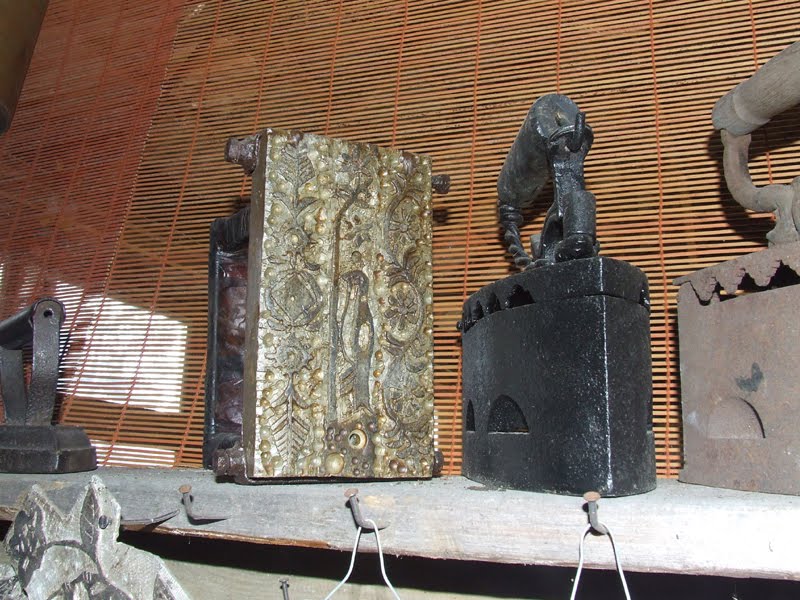
Ciekawe eksponaty w Muzeum Kurpiowskim w Wachu.

Odwiedzając Muzeum Kurpiowskie w Wachu natknąłem się na ciekawe eksponaty. Są to nakładki na żelazka, którymi niegdyś wypalano ozdoby na słomianych matach, ew. papierowych firankach. Interesujące?


Monday, June 27, 2011

Polski drzeworyt ludowy - zatopiony świat.

Dnia 14 czerwca 2011 roku odbyliśmy wycieczkę do Muzeum Etnograficznego w Warszawie w celu obejrzenia oryginalnych odbitek drzeworytniczych. Polski drzeworyt ludowy jest zapomnianą sztuką, a przecież jest tak piękny. Dzięki uprzejmości Dyrektora Muzeum, a także Pani Alicji Mironiuk Nikolskiej oraz Pani Amudeny Rutkowskiej mogliśmy zapoznać się z tym unikalnym rzemiosłem. Po wysłuchaniu bardzo ciekawego wykładu na temat, obejrzeliśmy oryginalną matrycę drzeworytniczą i udaliśmy się do archiwów muzeum, gdzie mogliśmy z bliska obejrzeć grafiki min ze słynnej teki Łazarskiego. Wyglądały jak świeżo odbite. Podczas odwiedzin w muzeum wywiązały się ciekawe dyskusje oraz nowe pytania, które mogą być zapowiedzią inspiracji.


Drzeworyt ludowy jest sztuką unikalną nie tylko ze względu na olśniewającą technikę, ale także sakrum w bardzo czystej formie, rzadko spotykane dziś w sztuce współczesnej i popularnej. Grafikę warsztatową należy oglądać w oryginale, dlatego cieszę się że mieliśmy możliwość obejrzeć eksponaty na żywo.

W drodze powrotnej obejrzeliśmy wystawę końcoworoczną na warszawskiej ASP.

Uczestnicy wycieczki:

studenci:
Agnieszka Demidiuk
Sylwia Hliwiadczyn
Iza Koszewska
Karolina Piaścik
Piotr Kobrzyński

opiekun koła:
dr Aleksander Woźniak